Roof Maxx before and after: how to read the photos, the videos and the bend test
October 19, 2026 · House Dressing
A real roof rejuvenation before and after is boring. The after photo should look like the same roof, a little darker for a few days, then back to normal. If you are hunting for Roof Maxx before and after photos to decide whether the treatment works, here is the honest answer: a photo is about the weakest proof there is, for Roof Maxx, for us and for anybody else spraying oil on shingles.
That is not a dodge. It is how the product works. The change happens inside the shingle, not on top of it, so the camera mostly misses it. Below is how to read the photos, the videos and the bend test you will be shown, and what to ask for on your own roof instead.
What a real before and after should look like
Rejuvenation puts oil back into asphalt that the sun has been baking out for years. There is no paint, no film and no shine. So the after photo should show the same roof. Our own FAQ puts it plainly: "For a few days after treatment, your roof will look slightly darker because the asphalt is fully saturated. Within a week or two the appearance returns to normal. No long-term color change."
Roof Maxx says much the same about its own treatment. Its myths page, updated June 23, 2026, says "Roof Maxx does not alter the color of a rooftop," that "the shingles may appear closer to their original color once the treatment has been applied," and that "sometimes it may look slightly better or newer afterwards." That is a careful, fair description, and credit where it is due.
The marketing runs a little warmer. Roof Maxx's page on roof rejuvenation, updated July 29, 2026, talks about making "your roof look newer again." One homeowner on its before and after page says "my roof looks like it was put on a few weeks ago instead of 21 years ago." He is clearly happy, and a happy customer is worth something. It is just not a measurement.
The rule of thumb: if a roof suddenly looks brand new in a photo, something else happened. It was cleaned, it was coated, or it was photographed differently. Cleaning is a fine service, but it is a different service. Our results page is built around exactly this: a good result is boring on purpose.
Five things that change a roof photo without changing the roof
Nobody has to lie for a before and after to mislead you. Shingles are surprisingly bad at holding still for the camera.
- Light, time of day and angle. The Asphalt Roofing Manufacturers Association, the shingle makers' own trade group, notes in its bulletin on color variation that color shading "typically varies with the time of day, light intensity, and viewing angle." Dark shingles show it most. A before shot in flat morning light and an after shot in low evening sun can look like two different roofs.
- A wet roof. Right after spraying, the shingles are saturated and darker. Our own results timeline calls that stage "post-spray surface with full saturation." An after photo taken that afternoon is a photo of wet shingles.
- Cleaning in the same visit. If moss, leaves or streaks came off before the spray went on, the after photo is showing you the cleaning.
- A different slope or a different distance. A drone shot from high up flattens a whole roof into one pleasant color. A close-up of the best looking slope proves nothing about the rest of the roof.
- The phone. A crop, a zoom, a filter, a nudge on the brightness. Easy to do and hard to spot.
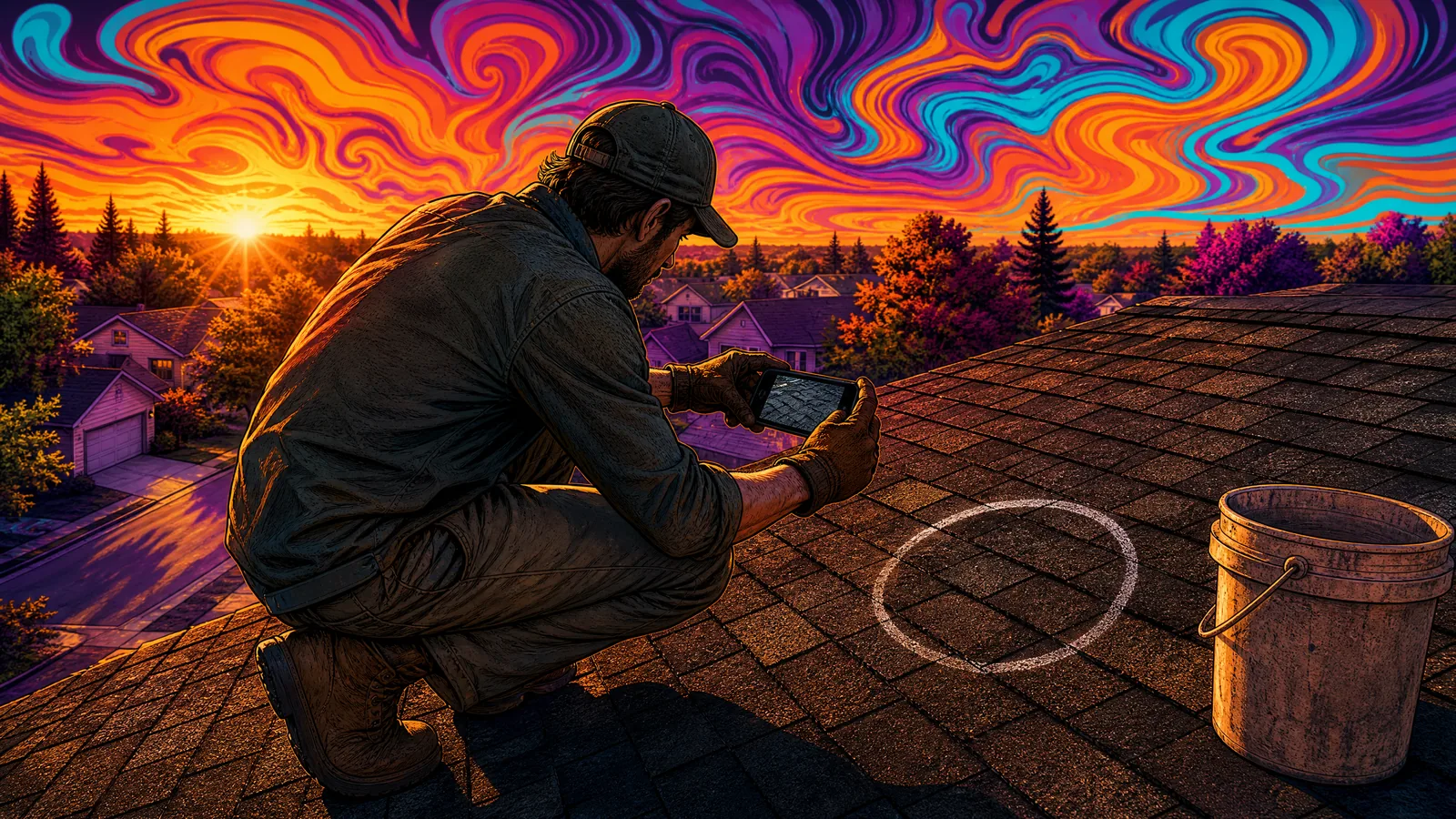
The fix is not complicated: same spot, same angle, similar light, a dry roof and a date on every photo. If a before and after cannot tell you those things, enjoy it as a nice picture. It is not evidence.
The bend test, and why temperature decides it
Then there is the bend test. Someone takes an old shingle, bends it until it cracks, then bends a treated one and it flexes. It makes great video. It can also mean very little.
Asphalt stiffens in the cold and softens in the heat. A shingle bent on a cold morning and a shingle bent on a warm afternoon are not taking the same test. Lyle Hogan, a registered roof consultant and engineer, made the point bluntly in a 2016 article published by IIBEC, the International Institute of Building Enclosure Consultants: "There is no such thing as a 'brittle test' for asphalt shingles," because "there is no singular identifiable temperature at which asphaltic materials become brittle." Asphalt, he wrote, is "a viscoelastic material," and "every test conducted on it is temperature-dependent." His question is the one to ask of any bend video you are shown: "Is the roof brittle in December or July?"
To be fair to everyone involved, Hogan was writing about roofers using a rooftop "brittle test" to talk homeowners out of repairs. He was not reviewing rejuvenation. But the logic carries straight over. Without "uniform constraints for the test procedure and environment," he wrote, "these evaluations would mean nothing."
So a bend comparison only counts if both bends use the same kind of shingle at the same age, at the same temperature, bent the same amount, with an untreated shingle bent right alongside. Bend hard enough and anything breaks. As one commenter on a pressure washing contractors' forum put it back in 2019, "You could bend a brand new shingle back on itself 180 degrees and it's going to break."
And please do not run your own bend test on your roof. A dried out shingle cracks when you flex it, so the test damages the thing it is testing, and walking an aged roof scuffs granules loose. What you can safely check from the yard is in our ground level checklist.
What controlled proof looks like
The grown up version of the bend test happens on a bench: a pliability test at a stated temperature, with treated shingles next to untreated ones.
Here is ours. In the manufacturer's technical data sheet dated 31 July 2026, treated shingles passed the pliability test at 55F and the untreated control did not. In the same table, the unnamed market-leading product also passed at 55F. So we are not going to pretend flexibility is where we pull ahead. Where our published numbers differ is granule adhesion: improved 50 percent against untreated shingles, against 17 percent for the market leader. Granules are the shingle's sunscreen, which is why that is the row we point people to. The science page walks through how it works.
Roof Maxx points to controlled testing too. Its page on roof rejuvenation describes an Ohio State University study on 17-year-old asphalt shingles, which found that "Shingles sprayed with Roof Maxx were significantly more flexible than untreated asphalt shingles." A side by side comparison against untreated shingles is better evidence than any video, theirs or ours.
One caveat, and it is ours, from our roof rejuvenation page: "Bench results are not a prediction for any particular roof." Condition, shingle type, weather, preparation and application rate all move the outcome. The bench tells you the product does something. Only your own roof, tracked over time, tells you what it did for you.
The before and after to ask for on your own roof
Forget the brochure. The before and after that counts is the one taken on your roof. Ask any applicator, whether that is a Roof Maxx dealer, one of ours or anybody else, for this:
- Close-ups of marked shingles before they spray. The same few shingles, marked or noted by location, dated, with the weather written down.
- Your gutters and the base of the downspouts, before treatment. Loose granules end up there, and a before photo gives any later shedding something to be compared against.
- Repairs and cleaning, photographed separately. If a nail pop was fixed or moss was cleared, you should know what changed and why, and not mistake it for the treatment.
- The same spots again once the roof has settled. Our results timeline shoots day 7. Same angle, similar light, dry roof.
- A check-in later, in similar weather. A July photo next to a January photo tells you about the seasons, not the shingles.
- The test data behind the product. The technical data sheet and any third-party test against untreated shingles. A company with plenty of before and after videos and no data sheet is telling you something too.
Then keep the file. For what to watch in the years after a treatment, see how long roof rejuvenation lasts.
To be plain about where we stand: our own results page is early. We are a young brand, and the page fills in as dealer crews complete treatments. It is set up as a timeline rather than a single glamour shot: aged shingle close-ups on day 0, the saturated surface two hours after spraying, the settled roof on day 7, a granule retention check at month 6, and a flexibility comparison against an untreated control roof at year 1.
Boring is the good sign
A rejuvenation before and after that looks dull is the treatment doing what it says: putting oil back where the camera cannot see it. The real proof is dated photos of your own roof, a data sheet and a test against untreated shingles, not a glamour shot.
If you want to see how we track it, start with our results timeline. If you would rather start with the chemistry, read the science. And if a before and after ever makes a 20 year old roof look brand new, enjoy the picture, then ask what else happened that day.
Common questions
Will my roof look new after a rejuvenation treatment?
No, and it should not. For a few days it looks slightly darker because the asphalt is fully saturated, then it goes back to normal within a week or two, with no long-term color change. Roof Maxx says much the same about its own treatment, that it 'does not alter the color of a rooftop'. If a roof suddenly looks brand new in a photo, it was usually cleaned or coated, which is a different service.
Is a shingle bend test proof that the treatment worked?
Only if both bends were done the same way: the same kind of shingle, the same temperature, the same amount of bend, next to an untreated shingle. Asphalt stiffens in the cold and softens in the heat, so a shingle bent on a warm afternoon will look better than one bent on a cold morning whether it was treated or not. A lab pliability test at a stated temperature against an untreated control is the version that means something, and House Dressing publishes one at 55F.
If I cannot see the change, how do I know the treatment is working?
Get a baseline. Ask your applicator to photograph a few marked shingles and your gutters before they spray, then photograph the same spots again later from the same angle in similar weather. Over the following seasons, watch for granules piling up in the gutters or shingle edges starting to curl. That record of your own roof is worth more than any before and after video.
Want the numbers for your roof or your market?
Drop your email and we send pricing, the dealer model, and the test data.
Get the pack →