Does roof rejuvenation remove black streaks? What the streaks are, and why cleaning comes first
October 26, 2026 · House Dressing
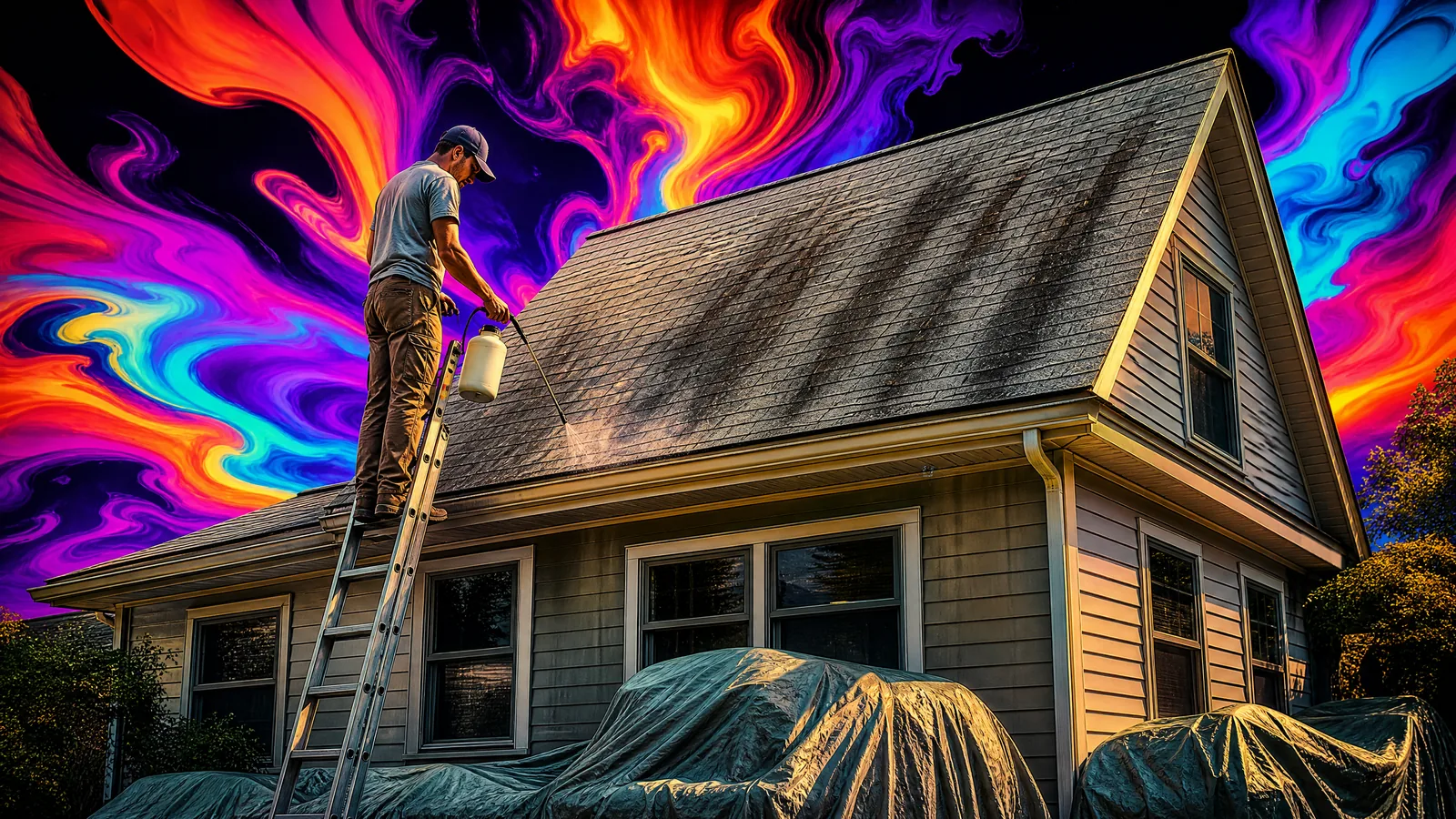
No. A roof rejuvenation treatment does not remove black streaks. It is not a cleaner, and nobody honest will tell you it is. Roof Maxx says the same about its own product, in so many words: "Roof Maxx will not remove existing moss/algae/mildew (black streaking) from the roof."
The streaks are usually algae. They make a roof look older than it is, and they say a lot less about its condition than a replacement salesman might suggest. Cleaning and rejuvenation are two different jobs. When a roof needs both, the cleaning comes first, and there is a chemistry reason for that order as well as a practical one.
Here is what the streaks are, what they do and do not mean, and what to ask before anyone books either job.
What the black streaks on your roof actually are
The Asphalt Roofing Manufacturers Association, the shingle makers' trade group, has a bulletin on exactly this. The discoloration, it says, "usually has a brown to black appearance and may be mistaken for fungus growth, soot, dirt, moss, or tree droppings."
The usual culprit has a name that sounds like a villain in a fantasy novel. In ARMA's words: "Gloeocapsa magma is probably the most prevalent of several algae species that contribute to discoloration. All species are transported through the air and tend to collect and grow on roofing structures and other outdoor surfaces."
Owens Corning calls it cyanobacteria and notes it "is commonly found on roofs with northern exposure." That is the slope that stays shaded and damp the longest. ARMA says it turns up almost everywhere, but most in muggy places: "Algae growth occurs to varying degrees in all regions of the U.S. and southern regions of Canada, especially those subjected to warm, humid conditions."
Moss is a different thing, and it is worth telling the two apart. Roof Maxx's guide to roof growth puts it simply: "Moss tends to grow upright while algae remain flat against the surface." Moss is the one that does physical harm. The same guide says moss "can directly harm the physical structure of your roof by lifting shingles and retaining moisture," while "algae is mostly cosmetic."
So: flat dark streaks, usually algae. Green fuzzy clumps, moss. Different problems, handled differently.
Do black streaks mean your roof is old or failing?
On their own, no. Owens Corning makes shingles and would happily sell you new ones, and it still says this plainly on its page about dark roof streaks: "Owens Corning has not seen evidence that algae deposits affect the performance of asphalt shingles. Algae, or streaking, is more of an aesthetic problem and may impact the look or curb appeal of your home."
So a streak is not a verdict, in either direction. A streaky roof can be perfectly sound. A clean looking roof can be drying out underneath. What tells you the roof's real condition is the shingle itself:
- Shingles that are stiff, curling or cracking.
- Bald spots where the granules have gone and the black asphalt shows through.
- Missing shingles, lifted tabs or damaged flashing.
- Any leak, or water stains on a ceiling.
Our page on roof rejuvenation puts it in five words: "Age matters less than condition." The same goes for looks. If you want to work through it yourself, our ground level checklist does it from the yard, no ladder required.
The practical upshot: do not let a streak sell you a new roof. And do not let it sell you a treatment either.
What rejuvenation does, and what it does not do about streaks
Rejuvenation does one specific job. It puts oil back into asphalt that the sun has been baking out for years, so the shingles stay flexible and hold on to their granules. House Dressing is built to soak into the shingle, not sit on top of it. Our technical data sheet says it flatly: "It is not a surface coating."
What it does not do is clean, kill or remove algae, moss, mildew or stains. Spray oil over a black streak and you get an oiled black streak.
To be fair to Roof Maxx, its answer here is straight. Its FAQ says: "Roof Maxx's main ingredient has a natural fungicide in it that will help to inhibit moss and algae growth. Roof Maxx will not remove existing moss/algae/mildew (black streaking) from the roof. We suggest that homeowners schedule a roof cleaning service prior to treating with Roof Maxx." The part about slowing regrowth is their claim about their product, and we will leave it with them.
For the record, House Dressing makes no algae claim. Not removal, not prevention. If anyone, us included, tells you a treatment keeps algae from coming back, ask to see the test.
One more thing to know before you look at anybody's photos. If a roof suddenly looks brand new after a "treatment," you are probably looking at the cleaning. Our results page says it directly: "Be skeptical of photos that show a roof suddenly looking brand new. That is usually cleaning or coating, not rejuvenation."
Why the roof gets cleaned before it gets treated
Two reasons, one practical and one chemical.
The oil has to reach the shingle. Step one of our application instructions is "Start with a clean roof that is fully dry." The prep list on our data sheet says the same thing in crew language: "Clear all debris from the roof surface" and "Surface must be fully dry at application." Roof Maxx explains why: "For Roof Maxx to work, it has to make direct contact with the surface of your shingles, and dirt, moss, or algae act like a barrier that blocks absorption either partially or completely." A layer of growth is a raincoat. The oil cannot soak through it.
The cleaner and the treatment do not mix. The standard way to lighten algae, per ARMA, is "a solution of liquid household bleach (sodium hypochlorite) and water." Bleach is an oxidizer, and our technical data sheet lists "Strong oxidizing agents" as incompatible with House Dressing. So these are two separate steps. The roof gets cleaned, rinsed and dried, and then it gets treated. Never one mix, never one tank, never one pass.
How long between the two? Neither our data sheet nor the guidance we read from ARMA, Owens Corning or Roof Maxx gives a fixed number, and we are not going to invent one. Ask your applicator how long they wait and how they know the roof is fully dry. A good one will have an answer that is better than "it'll be fine."
How to get streaks cleaned without hurting the shingles
The shingle makers' advice is consistent, and refreshingly gentle. ARMA's method, in plain words:
- Bleach and water, mixed to your shingle maker's directions. ARMA adds: "Other cleaning chemicals or methods should not be used without the approval of the shingle manufacturer."
- Sprayed on gently, never scrubbed. "Avoid scrubbing the surface, as this friction may loosen and remove granules."
- Left on, then rinsed. The solution "should be left on the roof for at least 15 minutes but no more than 20 minutes," then rinsed off gently with water.
- No pressure washer. ARMA uses capital letters for this one: "DO NOT use a power washer or any type of brush or broom to clean algae from the roof surface."
- Plants protected. Owens Corning says "all ground vegetation directly under the roof should be covered" before the solution goes on.
Two honest caveats. First, it does not last forever. ARMA says "The effectiveness of such cleaning is only temporary, and the discoloration may recur." Second, it is a job for a pro. A wet, bleached roof is slick, and ARMA says that too: "The cleaning process may make the roof slippery; therefore, ARMA encourages the use of professionals when attempting to clean shingles." We agree. Stay on the ground.
If a new roof is in your future anyway, algae resistant shingles are the long term answer. Owens Corning describes products that "incorporate metals, such as copper-lined mineral granules, to reduce algae growth." Roof Maxx's cleaning guide also mentions copper or zinc strips along the ridge.
You may also run into this line from Roof Maxx's cleaning guide: bleach based soft washing "can actually make your shingles dry out even faster." The guide does not cite a test for it, and ARMA and Owens Corning both describe a diluted bleach application as the way to lighten algae. When in doubt, follow your shingle maker.
Questions to ask before you book a cleaning and a treatment
If your roof needs both, get these answered, ideally on paper:
- Is cleaning included, or is it a separate line? Roof Maxx's own cleaning guide says some dealers clean "for an additional fee," and a few paragraphs later says the process "comes with complimentary basic cleaning." Both can be true. Ask what "basic" covers, and whether getting the streaks off is part of it.
- What will you clean with, and does it follow my shingle maker's directions?
- Any pressure washing? The right answer is no.
- How long between the cleaning and the treatment, and how will you know the roof is dry?
- How will you protect my plants, siding and gutters from the cleaning solution?
- What should the roof look like after each step? That way you know which change came from the cleaning and which came from the treatment.
Then get it written into the quote. Our guide to what a roof rejuvenation quote should say covers the rest of what belongs on it.
The short version
Black streaks are mostly a looks problem with a long scientific name. Cleaning handles the looks. Rejuvenation handles the dried out shingle underneath, if that shingle is still worth treating. Two jobs, done in that order, and neither one is a reason on its own to replace a roof.
If your roof is streaky and you are wondering whether it is still a candidate, start with how roof rejuvenation works and who it is for. Then get someone to look at the shingles, not just the stains.
Common questions
Will roof rejuvenation get rid of the black streaks on my roof?
No. Rejuvenation puts oil back into dried out shingles, it does not clean them. The black streaks are usually algae, and they are lightened with a gentle cleaning, not a treatment. Roof Maxx says the same about its own product. If your roof needs both, the cleaning comes first.
Do black streaks mean I need a new roof?
Not on their own. Owens Corning says it has not seen evidence that algae affects how asphalt shingles perform, and calls it more of an appearance problem. What matters is the shingle underneath: leaks, cracked or missing shingles, curling, and bald spots where the granules are gone. Have the roof checked for those before anyone prices a replacement.
Should my roof be cleaned before a rejuvenation treatment?
If there is algae, moss or debris on it, yes. The treatment has to soak into the shingle, and growth on the surface gets in the way. The roof also has to be fully dry when it is sprayed. Ask your applicator whether cleaning is in the price, what they clean with, and how long they wait before treating.
Want the numbers for your roof or your market?
Drop your email and we send pricing, the dealer model, and the test data.
Get the pack →