Roof rejuvenation equipment: what a roofer actually needs to add to the truck
October 4, 2026 · House Dressing
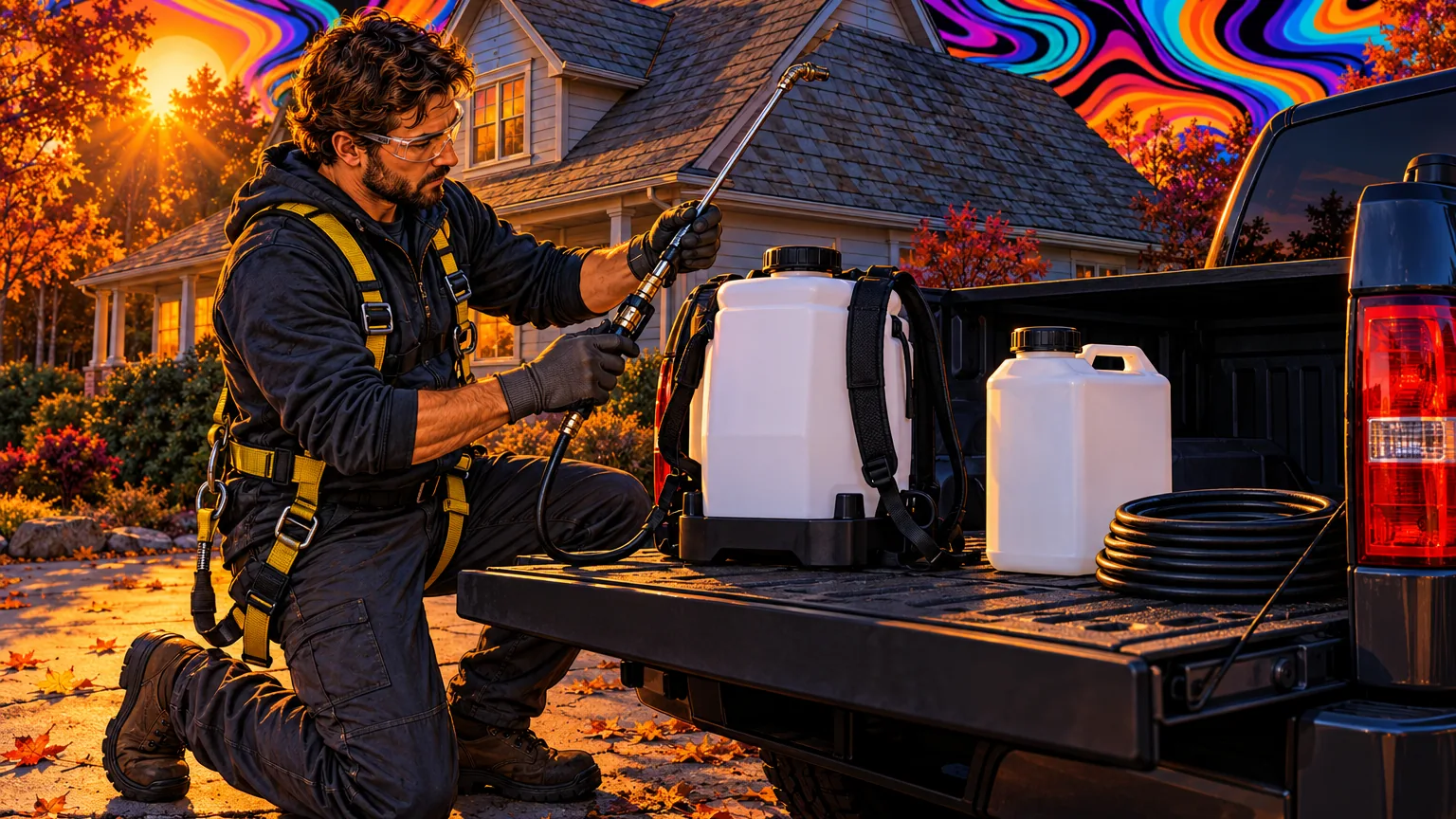
If you already run a roofing crew, you own the expensive half of a roof rejuvenation setup. Ladders, harnesses, anchors, a truck and people who are comfortable on a pitch are the hard part, and they are already paid for. What you add is short and cheap: a pump or backpack sprayer, a poly tank that only ever holds rejuvenation, something to measure and stir with, and the eye and skin protection most roofers do not normally wear. Our startup guidance puts the whole equipment line at roughly $1k to $3k, and a working roofer usually lands toward the bottom of that.
Here is the list, what each piece is for, and the few places where a cheap gear decision turns into an expensive afternoon.
What is already on your truck, and the short list you add
Start with what you do not need to buy. Rejuvenation is a walk and spray job on a sound roof. There is no tear-off, no dumpster, no nail gun and no compressor. Your fall protection, ladders and roof anchors carry straight over, and our technical data sheet lists a fall protection harness and high-grip footwear as required site gear anyway.
The add list:
- A sprayer. Backpack or pump style. More on choosing below.
- A dedicated tank in a compatible material, if you go bigger than a backpack.
- Measuring and stirring gear. A marked container so you measure the mix instead of guessing, and a paddle to stir the concentrate.
- Eye and skin protection. A face shield or safety glasses, and gloves. This is the item roofers skip, and it is the one the safety data sheet is most insistent about.
- Clean water on site for mixing and rinsing.
One thing that is not an equipment purchase: the Dealer Launch Kit. It is a good buy, but it is a sales kit. The $2,999 kit on our order page is one 5 gallon pail plus a dealer landing page, print files, the Roof Care Program agreement template, a CRM seat and thirty days of lead handling. No sprayer, no tank, no gloves. Budget those separately so the first delivery holds no surprises.
The sprayer: backpack, pump-up or a tank rig
Our data sheet names two sprayer types, backpack or pump style, and our order page sums the application up in five words: "put it on with a pump sprayer." This is a mist, not a coating. The diluted product goes on white, it is formulated to resist dripping, and you lay it down in smooth, overlapping passes. Nothing on the data sheet calls for an airless rig or a high pressure pump.
Three ways to set it up:
- Pump-up or battery backpack. The cheapest way in, and the right tool on steep or cut-up roofs where dragging hose is a hazard of its own. The tradeoff is refills. A full roof takes roughly 12 gallons of mixed material (the math is below), so a backpack means several trips back to the ladder.
- Tank rig with a hose reel. A tank on the truck or trailer, a 12V or 115V pump and a long hose up to the roof. One fill can carry an average roof and you stop climbing down to refill. For a price reference, one retailer, Outdoor Cleaning Store, lists a turnkey electric rejuvenation rig at $2,592 to $3,292 with the tank not included. That is where the top of the budget goes.
- Whatever you already own. If you run a soft wash side, you may already have a pump and hose that will do the job. Read the next section before you pour anything into that tank.
Whichever you pick, test the spray pattern on the ground before you go up. The data sheet asks for it, and a sputtering tip is a lot easier to fix in the driveway than on a 7/12 pitch.
Tank, pump and mixing, and why the soft wash rig stays separate
Size the tank from the published rate. House Dressing goes on at 200 sq ft per gallon of mixed material. A 2,500 sq ft roof needs about 12.5 gallons of mix, which at the 5:1 ratio is roughly 2.1 gallons of concentrate and 10.4 gallons of water. That lines up with the job math on our order page, and it means a tank in the 15 gallon range covers an average roof in one fill.
For the tank, pump and fittings, the data sheet lists compatible materials as carbon steel, 304 and 316 stainless steel, polyethylene, PVC and CPVC. For transfer, it names centrifugal, gear or diaphragm pumps. A plain poly tank with PVC fittings is fine. Most gear sold for spraying already fits that list.
Mixing is simple, but the order matters:
- Stir the concentrate for 5 to 10 minutes before you measure it. If it has been sitting, it may have settled.
- Mix five parts clean water to one part concentrate. Measure it. Do not eyeball it.
- If you are drawing from a hold tank, agitate the tank first.
- Never spray the concentrate straight. Our roof rejuvenation guide is blunt about it: undiluted product can damage the shingles.
Now the soft wash question, because every exterior crew asks it. Soft wash mixes run sodium hypochlorite, and sodium hypochlorite is an oxidizer. The data sheet lists strong oxidizing agents as incompatible with this product. So the answer is not "rinse it out really well." The answer is a separate tank and separate lines that only ever hold rejuvenation. A second poly tank costs a lot less than finding out what bleach residue does to a roof's worth of product.
The safety gear most rejuvenation guides leave out
Here is the part most guides skip. Plant-derived does not mean gentle on your eyes. The concentrate carries a DANGER signal word on its safety data sheet for two reasons: it causes serious eye damage, and it may cause an allergic skin reaction. You are misting it at roof level, sometimes into a breeze, so the eye risk is real.
What the safety data sheet calls for:
- A face shield or safety glasses, tested and approved under a recognized standard.
- Gloves, inspected before every use, taken off without touching the outer surface, with hands washed before breaks and at the end of the day.
- Avoid breathing the mist. Work with the breeze at your back where you can, and stay out of your own drift.
Then there is footing. Freshly treated shingles are slippery, and the data sheet says so outright: plan a safe exit route before you start, and do not walk on what you have already sprayed. In practice that means starting at the far side of the roof and working back toward your ladder, so the last patch you spray is the one you step off from.
Roof Maxx's own application and safety guidelines add a tip every crew should steal: overspray makes ladder rungs "extremely slippery," and they suggest wrapping each rung with slip resistant tape. Good advice whatever is in your tank.
Cleanup, and storing product when the nights turn cold
Cleanup is quick if you do it straight away. Flush the sprayer, hose and tank with clean water at the end of the job, which is also what Roof Maxx tells its own applicators. Pick a spot well away from the curb, because the safety data sheet says not to let the product enter drains.
Storage is where October catches people out. The data sheet says to store the product between 60 and 110°F, keep the container tightly closed in a dry, ventilated place, and never let it freeze. Its freezing point is 32°F. A pail riding around in an unheated truck, or sitting in a cold shop overnight in shoulder season, is outside that range well before the first frost. Bring it inside.
Two habits make this easy:
- Buy what you will spray this season. There is no minimum order and shipping is free in the US and Canada, so there is no reason to stockpile pails and ride out the winter with them in a cold garage.
- Respect the cure clock. The published cure times, 30 minutes tack free, 1 hour to foot traffic and 1 to 2 hours to full cure, are measured at 70 to 80°F and 50% humidity. Cure takes longer when it is cooler and damper. The roof has to be fully dry when you start, and you do not spray if rain or strong wind is expected. A fall morning with heavy dew means a later start, not a reason to push.
What the whole setup costs, and the easiest way to test your rig
Put together, here is the bill for a roofer who already owns the climbing gear:
- Sprayer, hose and safety gear: roughly $1k to $3k by our startup guidance, and less if you already own a pump and hose.
- Trial gallon, $360: covers about 1,200 sq ft. Use it to dial in your rig on a garage or one section before you put a full roof on the schedule.
- 5 gallon pail, $1,700: the working unit once jobs are booked.
- Dealer Launch Kit, $2,999: a pail plus the marketing side, if you want leads coming in while you learn.
That is a small outlay next to almost anything else you could add to a roofing business. The gear is the easy part. Deciding which roofs to spray is the hard part, and our walkthrough of a full rejuvenation job covers the walk, the prep and the close. If you would rather sell rejuvenation without owning a sprayer at all, that is a legitimate choice, and we laid out the math in white label versus spraying it yourself.
For the full specs, see the science page, where you can also request the technical data sheet. When you are ready to set up, the order page has the trial gallon, the pail and the kit.
Common questions
Can I run roof rejuvenation through my soft wash rig?
The same kinds of pumps and hose work, but do not share the tank. Soft wash mixes run sodium hypochlorite, which is an oxidizer, and our technical data sheet lists strong oxidizing agents as incompatible with House Dressing. Keep a dedicated poly tank and lines that only ever hold rejuvenation.
Does the Dealer Launch Kit come with a sprayer?
No. The $2,999 kit is one 5 gallon pail plus a dealer landing page, print files, the Roof Care Program agreement template, a CRM seat and thirty days of lead handling. Budget the sprayer and safety gear separately, roughly $1k to $3k, and a working roofer usually owns a good part of that already.
Do I need safety gear beyond my fall protection?
Yes, for your eyes and skin. The concentrate is classified as causing serious eye damage and may cause an allergic skin reaction, so the safety data sheet calls for a face shield or safety glasses and gloves inspected before use. Freshly treated shingles are also slippery, so plan your way off the roof before you start spraying.
Want the numbers for your roof or your market?
Drop your email and we send pricing, the dealer model, and the test data.
Get the pack →